

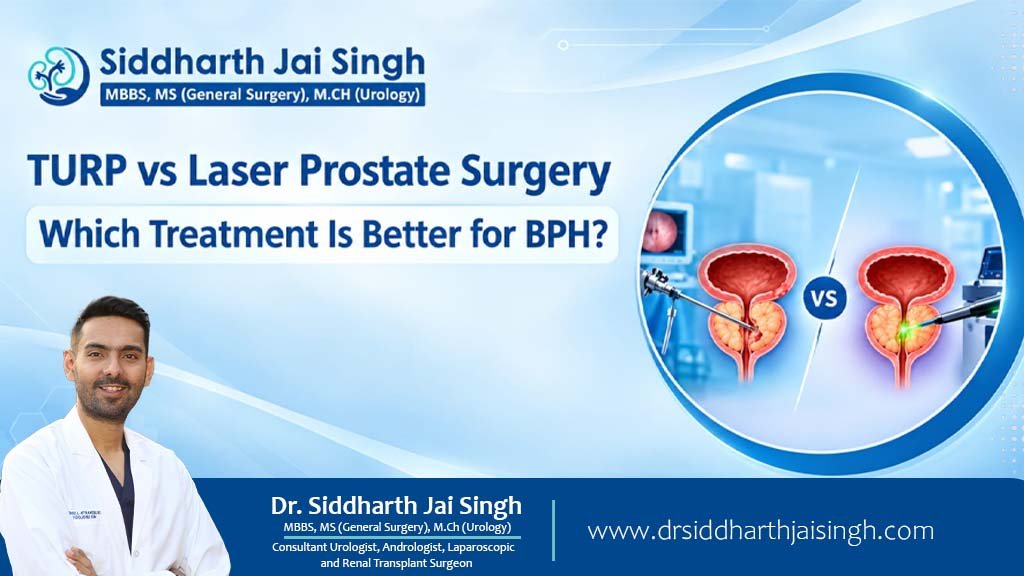
TURP vs Laser Prostate Surgery: Which Treatment Is Better for BPH?
Urine stream that is weak, frequent urge to urinate, difficulty with urination, as well as waking up at night often, can be signs of benign prostatic hyperplasia, also known as enlarged prostate. Prostate enlargement becomes a much more frequent problem for men.
Not all men suffering from BPH need to undergo surgical treatment. Many of them can manage the symptoms by changing their lifestyle, observation, or medicines. However, if symptoms become worse, or medications fail to work, the surgeon might suggest undergoing surgery in order to enhance urine flow.
There are two types of surgical treatments of BPH – TURP (transurethral resection of the prostate) and laser surgery. Which procedure is better? It depends on the person. Size of the prostate, symptoms, urinary blockage, state of health of the patient, type of laser surgery, and experience of the surgeon are among the factors to consider.
What Is BPH?
BPH (Benign Prostatic Hyperplasia) is a condition where there is an enlargement of the prostate which is not cancerous. Since the prostate encloses a portion of the urethra, an enlarged prostate causes constriction of the urethra thus affecting normal urine flow.
Symptoms include:
- Weak urine flow
- Difficulty starting urination
- Frequent urination in the daytime
- Urge to urinate
- Getting up many times during the night to urinate
- Leakage of urine after urination
- Incomplete emptying of the bladder
- Difficulty with urination
These symptoms vary greatly among individuals. In some cases, men having an enlarged prostate can show severe urination difficulties despite having a medium-sized prostate, while those with an enlarged prostate may have few difficulties with urination.
You can learn more about the condition, symptoms and causes in this guide to prostate enlargement and BPH.
Does Every Man With BPH Need Surgery?
No.
Management of BPH is dependent on the symptoms and the impact of the disease on one’s quality of life. Some men might require no more than surveillance and adjustment of their lifestyle, but others may require medication.
Surgical intervention usually becomes a consideration when the patient suffers from persistent symptoms that do not respond to medical therapy and BPH results in some complications.
Surgical intervention may be considered by the urologist when there are problems associated with obstruction such as recurrent retention of urine, infections in the urinary tract, development of bladder stones, or blood in the urine.
It is important to determine the reason for the symptoms of urine because trouble with urination does not necessarily mean the presence of BPH.
When Is BPH Surgery Recommended?
There is no single symptom or prostate size that automatically means surgery is required.
However, surgical treatment may be discussed in situations such as:
Persistent symptoms despite medication
If medicines have been prescribed appropriately but urinary symptoms continue to affect sleep, work, travel or daily activities, surgery may become an option.
Recurrent urinary retention
Urinary retention occurs when the bladder cannot empty properly. BPH is one of the common causes of urinary retention in men.
If you want to understand this complication in more detail, see this guide to urinary retention, its causes and treatment.
Recurrent urinary infections
Significant bladder outlet obstruction can contribute to incomplete bladder emptying and recurrent urinary problems. If infections repeatedly occur because of prostate obstruction, a urologist may consider treating the underlying obstruction.
Bladder stones
In some men, difficulty emptying the bladder can contribute to the formation of bladder stones. Treating the prostate obstruction may form part of the overall management.
Significant bleeding
BPH can sometimes be associated with blood in the urine. Persistent or significant bleeding requires proper evaluation to determine its cause and appropriate treatment.
Problems affecting the urinary tract
Long-standing obstruction can affect bladder function and, in more serious cases, kidney function. These situations require careful evaluation and may make surgical treatment more appropriate.
What Is TURP?
The abbreviation “TURP” is short for Transurethral Resection of the Prostate. TURP is one of the oldest surgical techniques that have been utilized to treat urinary obstruction due to BPH.
When undergoing TURP, a special tool is introduced via the urethra. It is a resectoscope that has a cutting loop to cut away the prostate tissue causing obstruction.
As the tool is introduced via the urinary tract, there is no need for making a conventional surgical incision externally.
The main purpose is to create a broader opening through the prostate gland to facilitate the free flow of urine from the bladder.
TURP has been applied for several decades and remains a crucial surgical procedure for BPH.
What Is Laser Prostate Surgery?
Laser prostate surgery employs laser energy in order to treat the prostate tissue causing obstruction to urination.
It is important to note that there is no one form of laser surgery. Depending on individual characteristics and needs of the patient, different types of laser surgery may be performed.
One of the laser surgeries performed is called Holmium Laser Enucleation of the Prostate (HoLEP).
In the latter type of laser surgery, laser energy is applied in order to separate and excise prostate tissue.
The particular type of laser surgery is important to consider when comparing TURP with laser surgery.
TURP vs Laser Prostate Surgery: Key Differences
Feature | TURP | Laser Prostate Surgery |
Access | Through the urethra | Through the urethra |
External incision | No traditional external incision | No traditional external incision |
Technology | Cutting loop | Laser energy |
Tissue treatment | Resects obstructing tissue | Enucleates or vaporises tissue depending on technique |
Procedure type | Established BPH surgery | Includes several laser techniques |
Suitability | Depends on prostate and patient factors | Depends on laser technique and patient factors |
Recovery | Varies by individual | Varies by technique and individual |
Both procedures aim to achieve the same broad objective: relieve obstruction and improve urinary flow.
The difference is primarily how the obstructing prostate tissue is treated.
What Are the Benefits of TURP?
TURP remains an important treatment option for several reasons.
Long-established procedure
TURP has been performed extensively and has a long history in the surgical management of BPH.
Removes obstructing tissue
The procedure directly removes prostate tissue that is narrowing the urinary passage.
Can improve urinary symptoms
By creating more space for urine to flow, TURP can significantly improve symptoms associated with bladder outlet obstruction in appropriately selected patients.
However, TURP is still a surgical procedure and has potential risks. The benefits and possible complications should be discussed with a urologist before treatment.
What Are the Benefits of Laser Prostate Surgery?
Laser procedures have become increasingly important in modern BPH treatment.
Depending on the technique, potential advantages can include:
Effective removal of obstructing tissue
Laser enucleation procedures can remove substantial amounts of prostate tissue responsible for obstruction.
Minimally invasive access
Many laser prostate procedures are performed through the urethra without a traditional external incision.
Can be used for different prostate sizes
Certain laser enucleation techniques can be used for a broad range of prostate sizes. However, suitability depends on the specific procedure and the surgeon’s experience.
Modern surgical technology
Newer technology in the form of laser treatments offers yet another option for dealing with prostate obstruction.
The key thing is that new technology does not necessarily equal improved patient care for all patients.
TURP vs Laser: Which Is Better for BPH?
There is no universal winner.
For one patient, TURP may be an appropriate choice. For another, a laser procedure such as HoLEP may be more suitable.
The decision may depend on:
- Prostate size
- Prostate anatomy
- Severity of urinary symptoms
- Degree of obstruction
- Bladder function
- Previous treatments
- Overall health
- Blood-thinning medication and bleeding considerations
- The specific laser technique available
- Surgeon experience
- Patient preferences
This is why treatment should be selected after a proper urological assessment rather than simply choosing the procedure that sounds newer or more advanced.
How Does a Urologist Choose Between TURP and Laser Surgery?
Before recommending surgery, a urologist may assess your symptoms, medical history and urinary function.
Depending on the individual case, evaluation may include:
- Physical examination
- Urine testing
- Blood tests
- Prostate assessment
- Measurement of urine flow
- Measurement of urine remaining in the bladder after urination
- Imaging when appropriate
The urologist may also consider the size and anatomy of the prostate.
A broader overview of BPH and other urinary conditions is available in this guide to common urological conditions and their treatments.
The aim is not simply to remove prostate tissue. The goal is to relieve obstruction, improve urinary symptoms and choose an approach that offers an appropriate balance between effectiveness, safety and recovery.
What Is Recovery Like After TURP or Laser Surgery?
Recovery varies according to the procedure, prostate size, individual health and whether complications occur.
A temporary urinary catheter may be required after prostate surgery to allow urine to drain while the urinary tract recovers.
During the early recovery period, some patients may experience:
- Burning while urinating
- Increased urinary frequency
- Urgency
- Mild blood in the urine
- Temporary urinary discomfort
- Changes in bladder control
These symptoms can improve as healing progresses.
Your urologist may recommend avoiding heavy lifting and strenuous activity for a period after surgery. Follow-up appointments are also important for assessing urinary improvement and recovery.
The exact recovery time differs between patients, so your surgeon’s instructions should take priority over general timelines found online.
What Are the Risks of TURP and Laser Prostate Surgery?
Both TURP and laser prostate procedures have potential risks.
Depending on the procedure and individual circumstances, possible complications can include:
- Bleeding
- Infection
- Temporary difficulty urinating
- Urinary urgency or frequency
- Urethral narrowing
- Bladder neck problems
- Need for additional treatment
Sexual side effects are also an important consideration.
Retrograde ejaculation can occur after some BPH procedures. This means semen travels backward into the bladder during ejaculation instead of leaving through the penis. It does not necessarily mean a loss of sexual desire or erectile function, but it can affect ejaculation and fertility.
Your urologist should explain these potential effects before you decide on surgery.
Can BPH Be Treated Without Surgery?
Yes.
Men suffering from BPH do not always require immediate surgery. Treatment can depend on the severity of symptoms and physical examination results.
For instance, the doctor can advise decreasing fluid consumption during evening time in case the problem is related to nocturnal urination, or other recommendations can be provided along with prescription of certain medications for relaxing the prostate and bladder opening.
However, when symptoms persist despite treatment and complications occur, long-term usage of these drugs may not be necessary.
The goal is to treat BPH at the proper moment and not to wait until urinary obstruction will occur.
BPH Treatment in Siliguri
If BPH symptoms are affecting your sleep, work, travel or quality of life, a proper urological evaluation can help determine whether medication or surgery is appropriate.
Dr. Siddharth Jai Singh is a Consultant Urologist, Andrologist, Laparoscopic and Renal Transplant Surgeon in Siliguri. If you have a weak urine stream, difficulty starting urination, frequent nighttime urination or repeated urinary retention, consult a qualified urologist for an appropriate diagnosis and treatment plan.
Conclusion
Both TURP and laser prostate surgery are well-established treatments for BPH when surgery becomes necessary. While TURP is an old surgical method, the use of laser technologies offers more choices to remove or treat obstructive prostate tissue.
But which one is better for BPH?
Unfortunately, there is not an easy answer for all men.
It depends on the prostate gland size and structure, symptoms, obstruction, general health, the used surgical procedure and skills of the surgeon.
If you are troubled by BPH and medications are not giving you relief anymore, a visit to a urologist will give you the answer.