

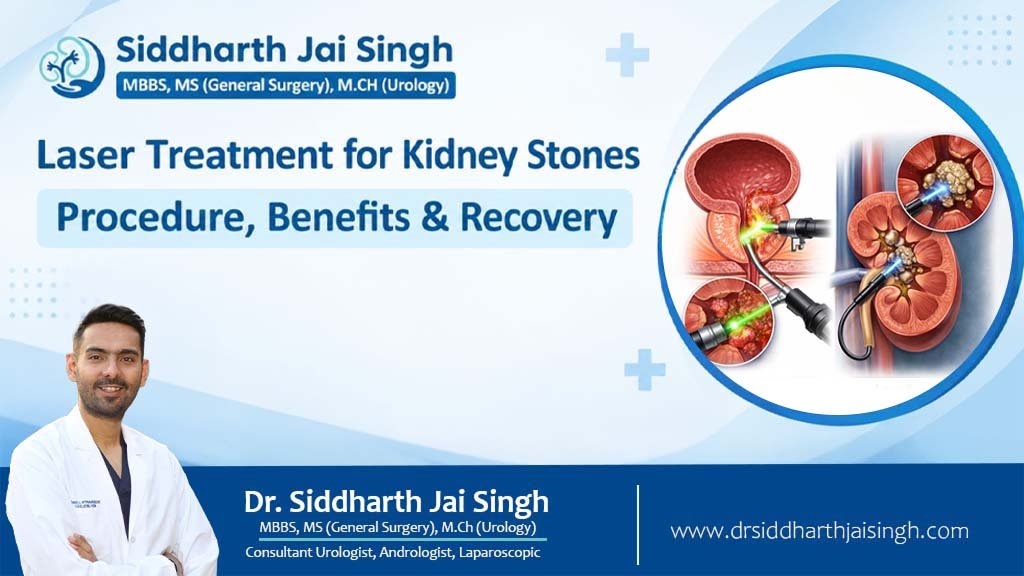
Laser Treatment for Kidney Stones: Procedure, Benefits & Recovery
Laser Treatment for Kidney Stones: Procedure, Benefits & Recovery Pain, difficulty urinating, hematuria, nausea, and vomiting may occur due to kidney stones. While kidney stones may sometimes pass naturally, there are situations where surgery is required to remove the stones. Laser kidney stone treatment is one of the common techniques for the removal of kidney stones, typically done by ureteroscopy procedure. Laser stone treatment technique enables a urologist to find and pulverize the kidney stone into pieces of dust or small fragments that are easily removable through urination. The technique does not involve making any cuts externally and depends upon the size and location of the stone. If you want to understand kidney stones in more detail, you can also read this guide on kidney stone symptoms, causes and treatment. What Is Laser Treatment for Kidney Stones? Laser therapy for kidney stones is a minimally invasive process that helps break up or remove stones from the urinary tract. Laser stone therapy is usually done when there is ureteroscopy and laser lithotripsy. In this case, a thin ureteroscope is inserted through the natural urinary tract into the bladder and then into the ureter or kidney. Once the stone is identified, a tiny laser fiber is used to fragment the stone. Based on the nature of the stone, the fragments can either be: Removed by a tiny basket Fragmented into extremely small fragments, often referred to as “dusting” Permitted to exit via the urine Since there is no incision made externally due to the use of the natural urinary tract, ureteroscopy can be done for stones in the ureter and selected kidney stones. When Is Laser Kidney Stone Treatment Recommended? It is not all cases of kidney stones that require laser therapy. Some smaller stones may be passed naturally through medical observation. Some situations that may prompt a urologist to suggest laser therapy include: When the stone cannot be passed naturally The stone causes continuous pain The stone blocks the passing of urine The stone causes recurrent problems with urination The presence of complications because of the stone The stone is in a situation in which ureteroscopy can be applied The unsuccessful application of some other procedure This will depend on various considerations. For a broader overview of treatment options, see the kidney stone treatment guide. How Does Laser Treatment for Kidney Stones Work? 1. Pre-procedure evaluation Before treatment, the urologist evaluates the stone and your overall health. Depending on the case, this may involve urine and blood tests along with imaging such as an ultrasound, X-ray or CT scan. Imaging helps determine the stone’s size and location and assists the urologist in choosing an appropriate treatment approach. 2. Anaesthesia Ureteroscopy with laser lithotripsy is generally performed under anaesthesia so the patient remains comfortable during the procedure. The exact anaesthesia plan depends on the procedure and individual circumstances. 3. Ureteroscope is inserted The urologist carefully passes a thin telescope through the urethra into the bladder and then towards the ureter or kidney. This allows the stone to be directly visualised without making an incision through the skin. 4. The stone is treated with a laser Once the stone is identified, a fine laser fibre is used to break it into smaller pieces. For suitable stones, the laser may be used to dust the stone into very small fragments. Larger fragments may instead be removed using a small retrieval basket. 5. A temporary stent may be placed In some cases, the urologist may place a temporary ureteric stent after the procedure. A stent helps maintain urine drainage while the ureter heals. Not every patient necessarily requires a stent, and its use depends on the circumstances of the procedure. Benefits of Laser Treatment for Kidney Stones Laser treatment has become an important option for managing many ureter and kidney stones because it combines direct stone access with minimally invasive treatment. Minimally invasive approach The procedure is performed through the natural urinary passage rather than through an external incision. This can reduce the need for conventional open surgery. Effective stone fragmentation The laser can break stones into smaller pieces or dust, making it possible to remove or pass the fragments. Direct visualisation Unlike treatments that rely only on external targeting, ureteroscopy allows the urologist to directly see the stone and treat it. Suitable for different stone locations Flexible ureteroscopes can allow treatment of stones located in parts of the kidney that may be difficult to access through other approaches. Short recovery for many patients Many patients can return home on the same day or after a short period of observation, depending on the procedure and their overall condition. Normal activities may often resume within a few days, although individual recovery varies. Laser Treatment vs Other Kidney Stone Treatments Laser treatment is not the only form of treatment available for kidney stones. The urologist would have to choose other methods such as observation, medicines, ESWL, or surgery depending upon the condition of the patient. The ESWL involves the use of external shock waves for breaking down the stones into tiny fragments that are able to come out along with urine. This is not similar to laser lithotripsy where the treatment takes place from inside using the ureteroscope. For bigger or more difficult to treat kidney stones, another form of treatment like PCNL would be recommended. Thus, there is no single best treatment for all patients. There are many factors that need to be considered before choosing the treatment method. Recovery After Laser Kidney Stone Treatment Recovery after ureteroscopy and laser lithotripsy is usually relatively quick, but some temporary symptoms can occur. You may experience: Mild burning while urinating Increased urinary frequency or urgency Mild discomfort Blood in the urine for a short period Discomfort related to a temporary ureteric stent These symptoms generally improve as the urinary tract heals. If a stent has been inserted, discomfort may continue until it is removed.
Laser Treatment for Kidney Stones: Procedure, Benefits & Recovery Read More »